Home / Warehousing and Fulfilment
Batch, Zone, and Wave Picking: How Orders Move Across a Fulfilment Centre
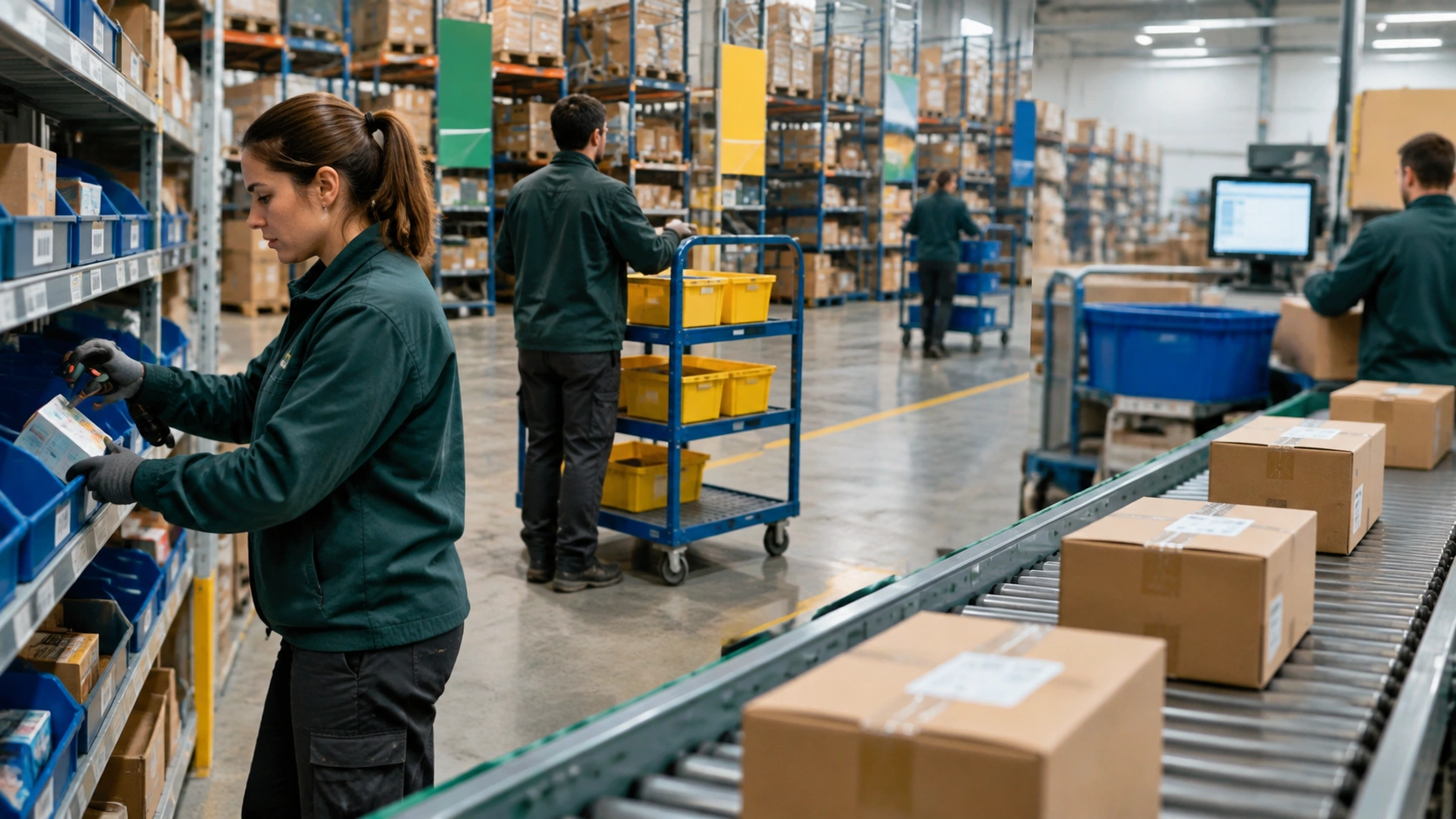
Walk onto a busy fulfilment centre and you will not see orders moving as neat, individual journeys. You will see work grouped, split, and released in carefully timed batches. The choices behind that movement sit at the heart of logistics and transport, because every extra metre travelled and every minute spent searching for stock adds cost before a parcel ever reaches a vehicle.
For anyone asking what are the main order picking methods used in fulfilment centres, the practical answer starts with three familiar approaches: batch, zone, and wave picking. They are not competing slogans. Each is a different way of organising how work crosses the warehouse floor, and each suits a different pattern of demand.
Batch picking: many orders, one trip
Batch picking means a picker collects items for several orders at the same time. Instead of completing one order, walking back, and starting the next, the picker follows a route that covers the combined requirements of a group of orders.
The simplest version uses a cart with separate compartments. The picker reads a single consolidated pick list, takes the quantity required for each location, and places the items into the correct order compartments while moving through the aisles. In a more advanced setup, a light-directed cart may show which quantity belongs in each tote, reducing the chance of mixing similar products.
Batch picking works best when many orders contain the same or similar items. If forty orders each need one unit of a popular product, a picker can take forty units from one location in a single visit. That removes repeated travel and shortens the time between receiving demand and preparing it for packing.
The method becomes less efficient when orders are highly varied or when items are bulky. A picker may need to handle large quantities, and cart space can become a constraint. Careful order sequencing, accurate carton or tote identification, and reliable scanning are essential to prevent one order from absorbing another’s items.
Zone picking: divide the floor, divide the work
Zone picking splits the warehouse into defined areas. Each picker stays within a zone and fulfils the items required from that section. An order containing products from three zones passes through three hands before it is complete.
This structure limits travel. Pickers learn their zones, stock locations become familiar, and congestion is reduced because teams are not repeatedly crossing the same aisles. It also supports specialisation: fragile goods, high-value items, or slow-moving stock can be handled by people with the right experience and equipment.
Zone picking creates a handover question. In a pick-and-pass system, a tote travels from zone to zone along a conveyor or a defined route, accumulating items as it goes. In a zone-and-consolidate system, each zone fills a separate container, and the containers are brought together at a consolidation station before packing.
Both versions require clear rules. Each zone must know when its portion of an order is finished, and the system must record where the order is at every stage. If a zone misses an item, the error may not become visible until much later, so scanning checkpoints and exception handling matter.
Wave picking: timing demand into manageable releases
Wave picking is primarily about when work is released. Rather than allowing orders to trickle into the floor continuously, the planning system groups them into waves aligned with carrier cut-offs, labour shifts, packing capacity, or delivery schedules.
A wave may contain orders that share a shipping method, a destination region, a promised dispatch time, or a common set of products. Pickers then work through that controlled release, often combining wave planning with batch or zone methods underneath.
The advantage is coordination. If a carrier collects parcels at 14:00, the warehouse can release the relevant orders early enough to leave time for picking, packing, and final checks. Waves also spread workload across the day, preventing a sudden surge from overwhelming one part of the operation.
The risk is rigidity. A tightly locked wave can leave pickers waiting if upstream information arrives late, while an oversized wave can create congestion and long queues at packing. Good wave design therefore depends on accurate order data, realistic task timing, and a buffer for urgent orders.
How the methods work together
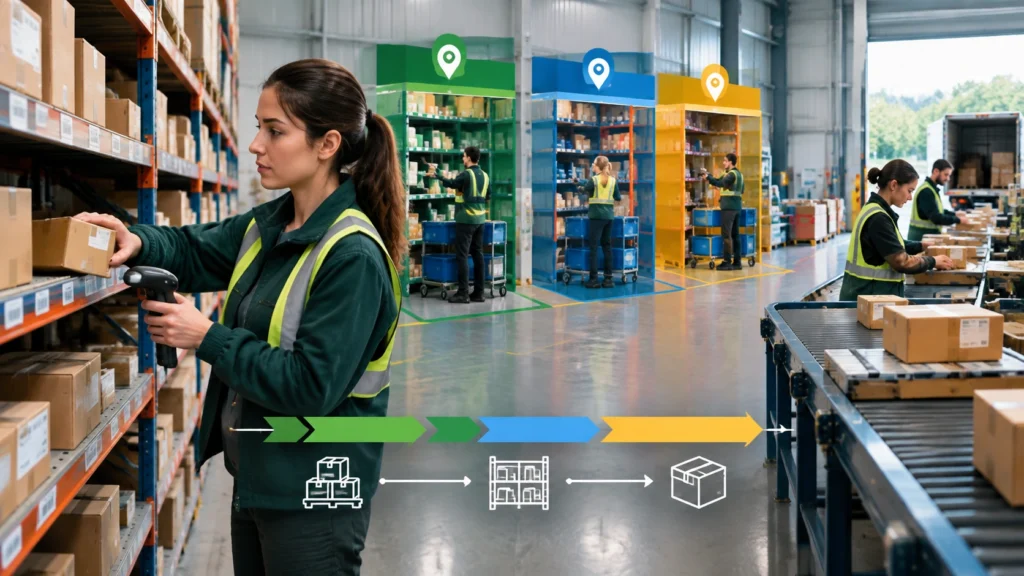
Most fulfilment centres do not rely on only one method. A common design uses waves to control release, zones to organise the floor, and batches to make each picker’s route productive. An order may enter at 09:30 as part of a wave, pass through three zones as a batched tote, and reach packing before the 11:00 carrier cut-off.
The right combination depends on the operation’s shape:
- Order profile: High volumes of similar items favour batching. Wide product variety may require zones.
- Warehouse layout: Long aisles and distant storage areas increase the value of zone picking.
- Dispatch schedule: Fixed carrier collections make wave planning especially useful.
- Product characteristics: Bulky, hazardous, or temperature-controlled goods may need dedicated zones and equipment.
- Technology: Barcode scanning, pick-to-light, mobile computers, and warehouse management systems determine how accurately work can be split and tracked.
What operators should measure
Choosing a method is only the first step. Performance depends on measurement. Useful indicators include lines picked per hour, travel distance per order, pick accuracy, order cycle time, queue length at packing, and the proportion of orders released on time.
These measures reveal whether a method is genuinely improving flow or simply moving the bottleneck. Batching may raise picks per hour while creating longer packing queues. Zone picking may reduce travel but increase waiting between handovers. Wave planning may protect carrier cut-offs while leaving labour unevenly loaded.
A floor-level view of the decision
The clearest way to understand picking is to follow an order. It is released as part of a wave, routed through the zones that hold its items, collected in a batch where products overlap, scanned at each handover, consolidated, packed, and handed to transport. Every stage answers a different question: when should work start, where should it happen, and how much should one person handle at once?
Batch, zone, and wave picking are therefore lenses on the same challenge. They help a fulfilment centre balance travel, labour, accuracy, and timing so that goods move smoothly from shelf to shipment without unnecessary delay.