
The Planning Process Behind Scheduling a Container Ship Across Ports and Oceans
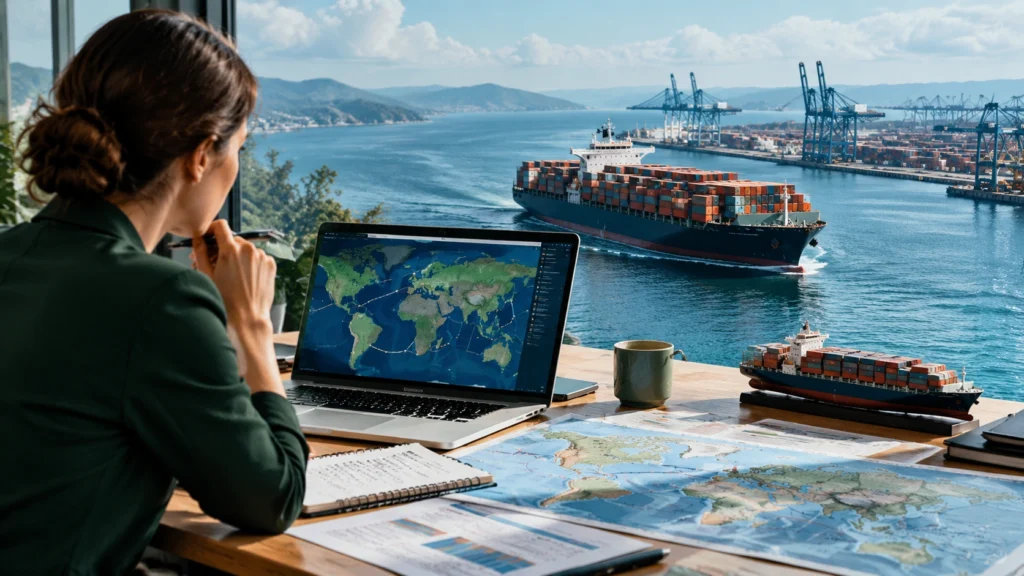
Behind every container ship that arrives on time is a planning process that balances geography, cargo demand, engineering limits, port operations, and weather. The work begins long before a vessel leaves its berth and continues throughout the voyage. Understanding logistics and transport at sea means seeing a schedule as a living plan rather than a fixed promise.
Start With the Service Network
A container line does not plan one ship in isolation. It designs a service network: a repeating pattern of port calls linked by ocean legs. The pattern may cover several regions and use multiple vessels so that cargo can move predictably from origin to destination.
Planners first define the trade lanes that need coverage. They consider where factories and distribution centers send containers, where importers need arrivals, and how much cargo is likely to move each week. The service must offer enough frequency to attract shippers while using ships and crews efficiently.
The next step is to choose a rotation, or the sequence of ports the vessel will visit. A rotation must make commercial sense. It should connect important cargo flows, limit backtracking, and avoid excessive distance. It must also respect the physical limits of the ship, including draft restrictions at certain ports and the size of cranes and berths.
Build the Schedule From Real Constraints
Once the rotation is set, planners calculate the time required for each segment. Sailing time depends on distance, planned speed, currents, tides, traffic separation schemes, and the need to arrive within a port’s available window. A ship cannot simply choose any speed; fuel consumption rises sharply as speed increases, and emissions rules may require slower operation.
Port stays are another major variable. Time is needed for mooring, pilotage, crane work, lashing checks, cargo discharge, loading, and departure formalities. The number of cranes, berth availability, labor schedules, and terminal congestion all affect how long a ship remains alongside. A container terminal may also limit the number of vessels it can handle at the same time.
Planners then add buffers. These allowances protect the schedule against small delays that are normal in shipping: waiting for a pilot, a late barge, a crane breakdown, or a brief weather interruption. Too little buffer makes the service fragile. Too much buffer wastes vessel days and weakens competitiveness.
Coordinate Ships Across the Loop
On a weekly service, several ships may sail the same rotation at regular intervals. Their spacing must remain even so that port calls and transshipment connections stay reliable. If one vessel falls behind, planners may adjust speed, move a port call, or change the order of operations to restore the pattern.
Connections matter as much as individual voyages. A ship’s arrival is planned around feeder vessels, rail services, trucks, and inland warehouses. A missed connection can create days of delay even when the ocean leg is completed on time.
Balance Cost, Emissions, and Reliability
Route planning is a constant trade-off. A shorter route saves time and fuel, but it may pass through congested straits or require expensive canal transit. A longer route may offer calmer conditions and better berth availability. Planners compare these options with the cost of slower steaming, additional crew time, and potential schedule risk.
Fuel is one of the largest voyage costs, so speed optimization is central to planning. Lines often choose a lower speed when cargo schedules allow it, then use reserve speed only when recovery is needed. Weather routing adds another layer: ships may adjust course to avoid heavy seas, strong headwinds, or risky visibility, even when the charted distance is slightly longer.
Environmental rules also shape decisions. Emission control areas, fuel-quality requirements, carbon reporting, and vessel-efficiency targets influence speed, fuel choice, and routing. The schedule must leave room for compliance without creating avoidable disruption.
Prepare for Disruption Before It Happens
No plan survives unchanged for long. Planners monitor port congestion, canal restrictions, storms, strikes, equipment failures, and changes in cargo demand. Modern operations use vessel tracking, terminal data, weather forecasts, and schedule-performance reports to detect risk early.
When a disruption occurs, the response is structured. The first question is whether the ship can recover time through a faster ocean passage without creating new problems. If not, planners may skip a port, exchange a call with another vessel, shift a departure window, or notify customers of a revised arrival.
Communication is part of the schedule. Terminal operators need updated arrival information to assign cranes and labor. Trucking companies need realistic windows to book appointments. Shippers need enough notice to prepare warehouses and arrange collection. A schedule is therefore not only a navigation plan; it is a shared operating agreement.
Review the Plan After Every Voyage
After a ship completes its rotation, planners compare planned performance with actual performance. They examine waiting times, canal delays, berth productivity, weather losses, and connection reliability. The findings feed into the next schedule revision.
This review process explains why shipping schedules change over time. A route that looks efficient on a map may perform poorly in practice because of repeated congestion or weak crane productivity. Another route may be slightly longer but produce more dependable arrivals.
In short, the answer to how do container shipping lines plan vessel routes and schedules is a cycle: design the service, calculate realistic port and ocean times, protect the plan with buffers, coordinate connections, optimize speed and fuel, monitor risk, and revise from evidence. The result is not perfection. It is a disciplined system for moving containers across ports and oceans while keeping cost, safety, and reliability in balance.