Logistics and Transport Explained: A Complete Guide to Moving Goods from Origin to Destination
Every product that reaches a customer travels through a series of carefully planned steps. Logistics and transport are the disciplines that make this movement possible, linking suppliers, producers, warehouses, and customers into a reliable flow. This guide explains how goods move from origin to destination, the roles involved, the decisions that shape cost and service, and the practices that keep supply chains resilient.
What is logistics and transport in supply chain management
At its core, logistics is the end-to-end coordination of how goods are stored, handled, and delivered. Transport is the physical movement between locations. In supply chain management, logistics and transport work together to plan routes, select carriers, manage inventory, and control costs while meeting delivery promises. They connect procurement, production, warehousing, and customer service so that materials and finished products arrive where they are needed, when they are needed.
The journey from origin to destination
Goods typically follow a path that includes several stages:
- Origin preparation: Orders are created, production schedules are set, and goods are packed, labeled, and documented for movement.
- Pickup and first mile: A carrier collects freight from the supplier or factory and moves it to a hub, port, or consolidation point.
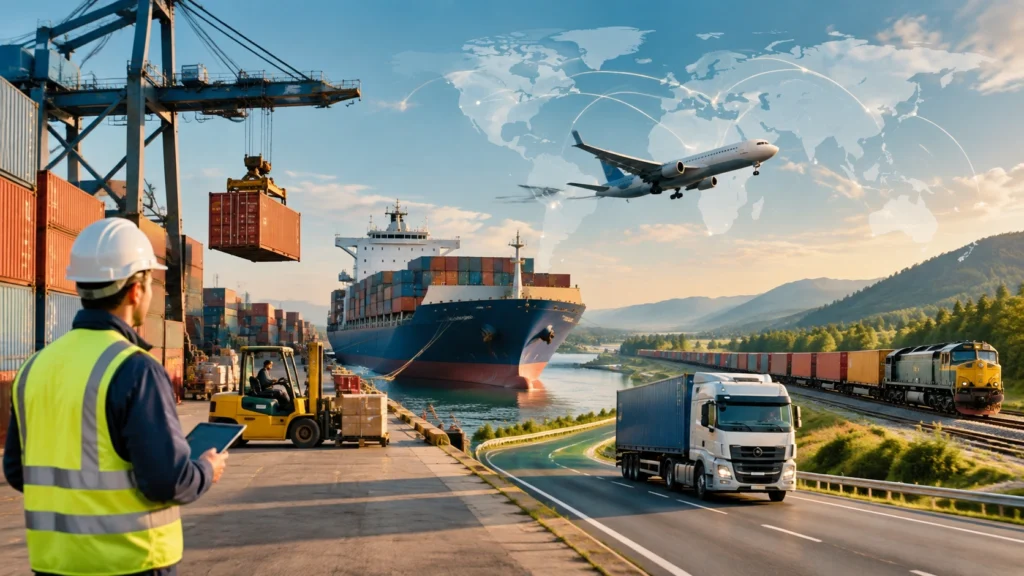
- Linehaul and transfer: Freight travels long distances between hubs, terminals, or ports using trucks, rail, ocean vessels, or aircraft.
- Warehousing and consolidation: Goods may be sorted, cross-docked, stored, or combined with other shipments to reduce cost and improve efficiency.
- Last mile delivery: The final leg takes goods to the customer, retail location, or jobsite, often with tight delivery windows and precise tracking.
Each stage introduces decisions about speed, cost, risk, and service. Effective logistics aligns these choices with business goals and customer expectations.
Key roles and responsibilities
Successful movement depends on clear roles across the supply chain:
- Shippers: Companies that need goods moved, including manufacturers, retailers, and distributors. They define requirements, budgets, and service levels.
- Carriers: Trucking lines, rail operators, ocean carriers, and airlines that physically transport freight. They manage fleets, crews, and compliance.
- Freight forwarders and brokers: Intermediaries that arrange transport, consolidate shipments, handle documentation, and match capacity with demand.
- Warehouse operators: Teams that manage storage, inventory accuracy, packing, and order fulfillment.
- Customs and compliance specialists: Professionals who manage import and export rules, tariffs, and documentation for international moves.
- Technology and data teams: Staff that maintain visibility platforms, track shipments, and analyze performance.
Modes of transport and when to use them
Choosing the right mode is a central decision in logistics. Each mode has strengths and trade-offs:
- Road (trucking): Flexible door-to-door service, broad coverage, and frequent departures. Ideal for regional and national shipments, time-sensitive loads, and last mile delivery.
- Rail: Cost-effective for bulk and long-haul moves. Well suited to heavy or dense goods, though transit times can be longer and schedules less flexible.
- Ocean: The backbone of international trade. Economical for large volumes and long distances, with longer lead times and port-centric planning.
- Air: Fastest option for urgent or high-value goods. Higher cost per kilogram, with strict weight and security requirements.
- Multimodal and intermodal: Combining modes, such as rail plus truck or ocean plus truck, to balance cost, speed, and reliability. Requires careful coordination and transfer planning.
Mode selection depends on product characteristics, lead time, cost targets, service requirements, and risk tolerance.
Planning the flow: network design and inventory
Logistics planning begins with network design. This includes decisions about where to source materials, where to produce, where to hold inventory, and how to route shipments. Companies use data to balance transportation costs, warehousing costs, service levels, and risk. Inventory placement affects both speed and cost: positioning goods closer to customers improves delivery times, while centralizing inventory can reduce stock levels and simplify management.
Forecasting and demand planning support these decisions. Accurate forecasts help align production, storage, and transport capacity, reducing waste and improving reliability. When forecasts are uncertain, companies build flexibility into contracts, capacity plans, and safety stock.
Documentation, compliance, and risk
Every shipment carries information that must be accurate and complete. Common documents include bills of lading, commercial invoices, packing lists, customs declarations, and certificates of origin. Errors create delays, penalties, and unhappy customers. Compliance teams verify classifications, duties, and restricted items before movement begins.
Risk management is essential. Weather events, port congestion, equipment failures, and labor shortages can disrupt flows. Companies mitigate risk by diversifying carriers and routes, maintaining buffer stock, using insurance, and monitoring real-time data to respond quickly to exceptions.
Technology that enables visibility and control
Modern logistics relies on technology to manage complexity. Transportation management systems plan routes, book capacity, and optimize loads. Warehouse management systems control receiving, storage, picking, and shipping. Visibility platforms track shipments across modes and provide alerts for delays or deviations.
Data analytics improves decision-making by revealing cost drivers, service patterns, and bottlenecks. Automation in warehouses, such as barcode scanning and conveyor systems, increases speed and accuracy. Digital documentation reduces manual work and errors, while electronic data interchange and APIs connect partners for faster information flow.
Cost, service, and the trade-off balance
Logistics leaders constantly balance cost and service. Faster transport and higher inventory improve delivery performance but increase expense. Slower modes and lean inventory reduce cost but raise the risk of stockouts or late deliveries. The right balance depends on customer expectations, product value, competition, and business strategy.
Practical levers for optimization include load consolidation, mode shifts, route optimization, collaborative shipping, and improved packaging to reduce damage and dimensional weight. Regular performance reviews and contract negotiations help maintain alignment between cost and service goals.
Sustainability in logistics and transport
Companies are increasingly measuring and reducing the environmental impact of freight. Strategies include shifting to lower-emission modes where feasible, optimizing routes to cut fuel use, improving load factors, and choosing carriers with strong environmental programs. Packaging design can reduce waste and improve transport efficiency. Reporting frameworks and customer expectations are pushing sustainability from a side activity to a core part of logistics management.
Building resilient supply chains
Resilience comes from preparation and adaptability. Diversified sourcing and carrier base reduce dependence on single points of failure. Clear communication between partners speeds problem-solving. Contingency plans, alternative routes, and pre-approved escalation paths keep goods moving during disruptions. Continuous improvement, supported by data, turns lessons learned into stronger processes over time.
Putting it all together
Logistics and transport are the practical engine that turns supply chain plans into deliveries. By coordinating people, processes, and technology across every stage, companies move goods from origin to destination with the right balance of cost, speed, and reliability. Understanding these fundamentals helps teams make better choices, serve customers more consistently, and build supply chains that perform in both calm and challenging conditions.